Updated November 2026 · 23 sources · Printable chart below
Most bad smells are a chore. These eight are warnings. Here is what each one can mean, the first thing to do, and the guide with the full fix. If you are smelling one of the top five right now, stop reading and do the first step.
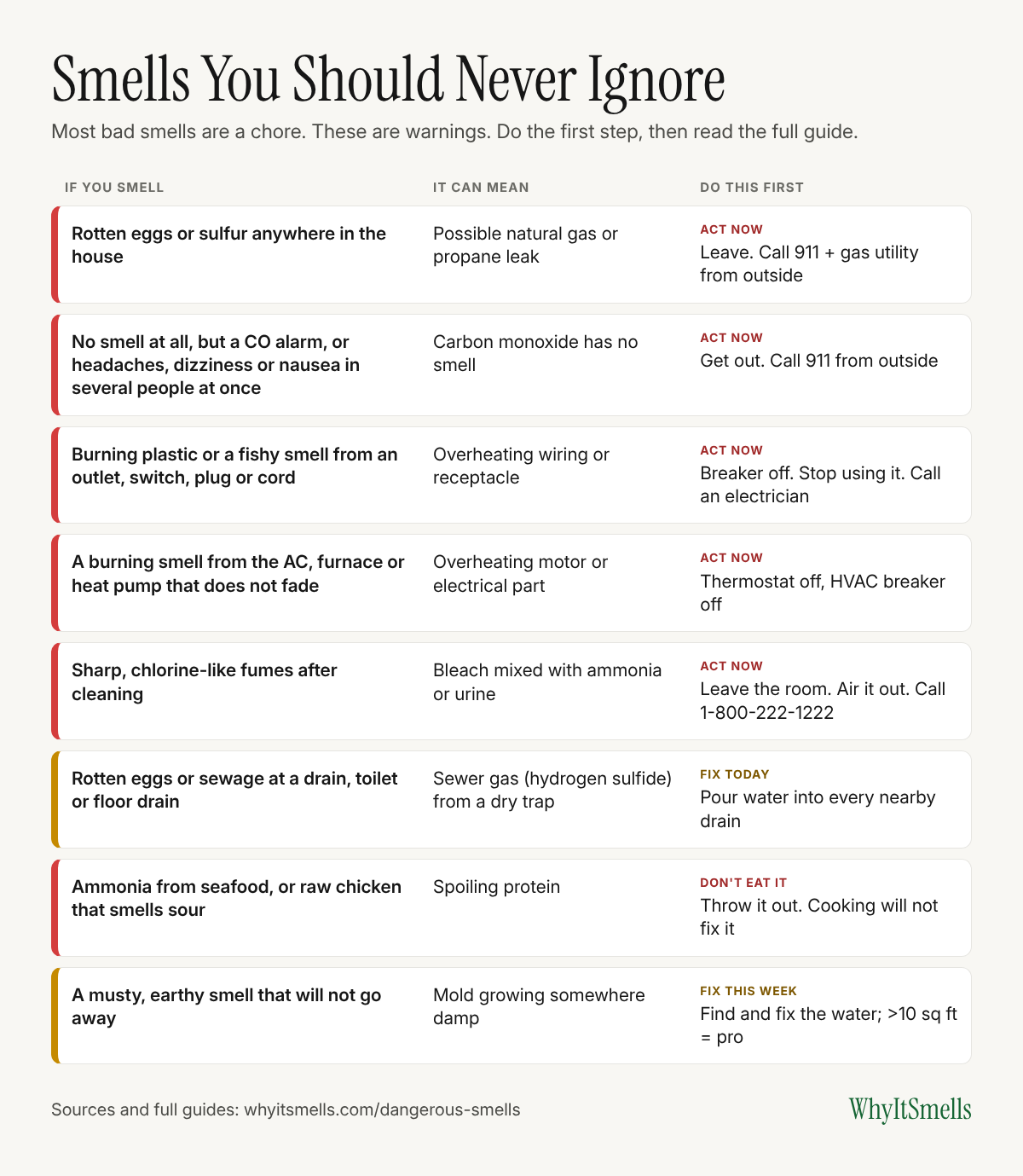
Rotten eggs or sulfur anywhere in the house
Act nowWhat it can mean. Natural gas has no smell of its own; utilities add mercaptan, a sulfur compound, so a leak smells like rotten eggs 1. A burner can give off a brief whiff as it lights, but GE says smelling unburned gas in your home is not normal 2.
Do this nowLeave now and take everyone with you. Do not touch light switches, phones or the garage door opener on the way out, and do not hunt for the leak. Call 911 and your gas utility from outside 13.
No smell at all, but a CO alarm, or headaches, dizziness or nausea in several people at once
Act nowWhat it can mean. Carbon monoxide has no odor, taste or color 4. Symptoms that ease when you step outside, or that hit people and pets at the same time, point to CO rather than a bug 5.
Do this nowGet everyone out and call 911 from outside. Do not go back in until the fire department or utility says it is safe 56.
Burning plastic or a fishy smell from an outlet, switch, plug or cord
Act nowWhat it can mean. Warm or discolored outlets and a burning smell are electrical warning signs 78. Some guides say overheating insulation smells fishy 9; a Massachusetts deputy fire chief says he has never seen that link and describes acrid burning plastic 10. Treat either smell the same way.
Do this nowTurn off that circuit at the breaker, unplug what is in it if you can do so safely, and do not use it until an electrician has checked it 11. Flames or smoke: get out and call 911 9.
A burning smell from the AC, furnace or heat pump that does not fade
Act nowWhat it can mean. In cooling mode, a burning smell most often points to an overheating electrical part or motor 12. The normal exception is dust burning off on the first heat of the season, which should fade within roughly 10 to 60 minutes 1314.
Do this nowSet the thermostat to Off and switch off the HVAC breaker. Smoke, sparks or flames: leave and call the fire department 14.
Sharp, chlorine-like fumes after cleaning
Act nowWhat it can mean. Bleach mixed with ammonia, including the ammonia in urine, releases chloramine gas 1516.
Do this nowGet out of the room, open a window and run a fan 15. Call Poison Help at 1-800-222-1222, free and open 24/7 15. Shortness of breath or chest pain needs medical care right away 17.
Rotten eggs or sewage at a drain, toilet or floor drain
Fix todayWhat it can mean. Sewer gas carries hydrogen sulfide, which smells like rotten eggs {osha_h2s}. In homes it usually gets in through faulty plumbing such as dry drain traps 18. At higher levels it overwhelms your nose, so a smell that fades is not proof the gas is gone 18.
Do this nowPour about a quart of water into every sink, tub, shower and floor drain nearby 19. If you cannot tell sewer gas from a gas leak, treat it as gas and call the utility 1.
Ammonia from seafood, or raw chicken that smells sour
Don't eat itWhat it can mean. Spoiled seafood can smell sour, rancid, fishy or like ammonia, and FDA says those odors get stronger after cooking 20. Fresh raw chicken keeps 1 to 2 days in the refrigerator 21.
Do this nowAny ammonia smell in cooked seafood, fleeting or persistent, means do not eat it 20. Chicken past its 1 to 2 days, or with a smell that does not air out, goes in the trash.
A musty, earthy smell that will not go away
Fix this weekWhat it can mean. EPA says a moldy odor means mold is growing and should be investigated 22. It often hides on the back of drywall, under carpet pad or around leaking pipes 23.
Do this nowFind and fix the water source first. Patches larger than about 10 square feet are EPA's line for bringing in a professional 23.
Not on this list? Most smells are not emergencies. Use the Smell Finder to match yours to a guide, or test yourself with the smell safety test.
Quick answers
What smells in a house are dangerous?
The ones to act on immediately are rotten eggs or sulfur anywhere in the house (possible gas leak), burning plastic or a fishy smell from an outlet or cord (overheating wiring), a burning smell from heating or cooling equipment that does not fade, and sharp chlorine-like fumes after mixing cleaners. Carbon monoxide is the dangerous one you cannot smell at all.
What does a gas leak smell like?
Like rotten eggs or sulfur. Natural gas has no smell of its own, so utilities add mercaptan, a sulfur compound, to make leaks noticeable. If you smell it, leave the house and call 911 and your gas utility from outside.
Can you smell carbon monoxide?
No. Carbon monoxide has no odor, taste or color. A carbon monoxide alarm is the only reliable warning; symptoms such as headache, dizziness and nausea that ease when you go outside are another sign.
Is sewer gas dangerous?
Sewer gas carries hydrogen sulfide, which smells like rotten eggs. Usually the cause is a dry drain trap, fixed by pouring water down the drain. At higher concentrations hydrogen sulfide overwhelms your sense of smell, so a smell that fades is not proof the gas is gone.
Sources
- Natural Gas Safety — Kansas Corporation Commission (state utility regulator)
- Gas Range - Gas Odors — GE Appliances
- Recognizing a Leak — Atmos Energy
- Carbon monoxide poisoning: Symptoms and causes — Mayo Clinic
- Carbon Monoxide brochure — Minnesota Department of Health
- CO Alarms (Carbon Monoxide Information Center) — U.S. Consumer Product Safety Commission
- Electrical Safety Dos — Electrical Safety Foundation International
- NFPA Safety Tips: Electrical Safety — National Fire Protection Association
- A Smelly Warning: Electrical Fires Smell Like Fish — HomeServe
- Massachusetts Fire Officials Warn That a Fishy Smell Could Mean Something Far Worse — WUPE (Pittsfield, MA)
- Electrical Outlet Safety Guide: Warning Signs, When to Replace, FAQs — Leviton
- What Does an AC Burning Smell Mean? — HVAC.com
- Does Your Heat Smell Like It's Burning? — Trane
- Heat Pump Smells Like Burning: Causes, Safety Steps, and Fixes — PickHVAC
- Some Things Just Don't Mix — Missouri Poison Center
- Dangers of Mixing Bleach with Cleaners — Washington State Department of Health
- Bleach and Urine: Is It Safe to Mix? — Healthline (medically reviewed)
- Hydrogen Sulfide Gas — Illinois Department of Public Health
- Why do I have sewer smells in my Home or Business — Village of Almont, Michigan
- Selecting and Serving Fresh and Frozen Seafood Safely — U.S. Food and Drug Administration
- Refrigerator & Freezer Storage Chart — U.S. Food and Drug Administration
- What does mold smell like? — U.S. Environmental Protection Agency
- A Brief Guide to Mold, Moisture and Your Home — U.S. Environmental Protection Agency